
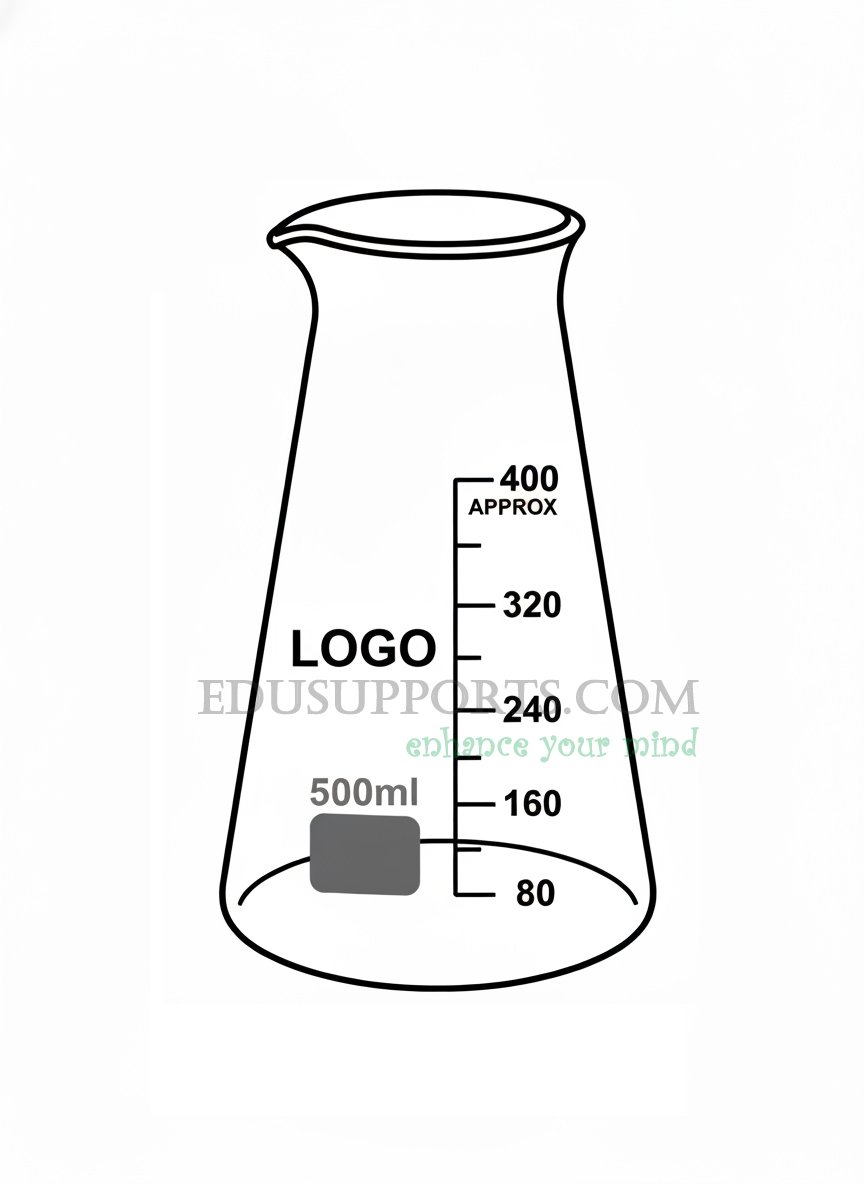
Phillips Conical Beaker (Triangular Beaker / Conical Beaker) with Spout & Printed Graduation – Borosilicate Glass – For Mineral & Alloy Analysis
Product Overview
The Phillips conical beaker—also known internationally as the conical beaker, triangular beaker, Philips beaker, or Fries beaker—is a unique hybrid design that combines features of both standard beakers and Erlenmeyer flasks. Unlike straight-walled Griffin or Berzelius beakers, this vessel features a conical shape: a wide, stable base that tapers to a narrower mouth.
This distinctive geometry was developed to address specific needs in the steel and geological industries. The wide base provides exceptional stability and expanded heating surface, while the narrow mouth reduces evaporation and prevents splashing during vigorous reactions. The shape also allows for swirling without risk of contents spilling out—making it ideal for titration work and as a receiving vessel for atmospheric distillation.
EduSupports brings you this specialized laboratory vessel, manufactured from premium borosilicate glass 3.3, complying with ISO 3819 and DIN 12331 standards.
Key Features
Conical (Phillips) design – wide base (ø50-116mm) tapers to narrow mouth (ø32-62mm) for stability and reduced evaporation
Large, stable base – expands heating surface and prevents tipping during oscillatory mixing
Narrow mouth – reduces volatile losses and prevents splashing and foaming over
Single pouring spout – drip-free, controlled pouring
Reinforced rolled rim – mechanical strength and safer gripping
Borosilicate glass 3.3 – excellent thermal shock resistance and chemical durability
Suitable for vigorous agitation – tapered shape allows swirling without spillage
Wide size range – from 50mL to 1000mL, plus 125mL option
Why Choose the Phillips Conical Design?
The Phillips conical beaker offers several unique advantages that neither standard nor tall-form beakers can match.
| Characteristic | Phillips Conical | Griffin (Low-Form) | Berzelius (Tall-Form) |
|---|---|---|---|
| Shape | Wide base, narrow top | Straight, wide | Straight, narrow |
| Stability | ⭐⭐⭐⭐⭐ Excellent | ⭐⭐⭐⭐ Good | ⭐⭐⭐ Moderate |
| Swirling ability | ⭐⭐⭐⭐⭐ Excellent | ⭐⭐ Limited | ⭐⭐ Limited |
| Evaporation control | ⭐⭐⭐⭐ Low | ⭐⭐ Moderate | ⭐⭐⭐ Moderate |
| Heat distribution | ⭐⭐⭐⭐ Wide surface | ⭐⭐⭐ Moderate | ⭐⭐⭐ Moderate |
| Best for | Titrations, mineral analysis, alloy testing | General heating/boiling | Foaming liquids, oils |
First, the wide base provides exceptional stability. When working with hot plates or performing oscillatory mixing, the large footprint prevents tipping—a critical safety feature when handling corrosive or hazardous samples.
Second, the narrow mouth reduces volatile losses. In steel and geological analysis, boron-containing materials are often heated for extended periods (boron converts to pyroboric acid at 140-160°C, which volatilizes in steam). The narrow opening minimizes this loss.
Third, the conical shape enables vigorous swirling without spillage. This is particularly valuable during titration operations, where consistent mixing is essential for accurate endpoint determination.
Fourth, the wide base expands the heating surface, promoting uniform heat distribution and faster temperature ramping.
Specifications – Find Your Perfect Size
| SKU | Capacity (mL) | O.D. at Top (mm) | O.D. at Base (mm) | Height (mm) |
|---|---|---|---|---|
| 0503010030-01 | 50 | 32 | 50 | 70 |
| 0503010030-02 | 100 | 38 | 59 | 92 |
| 0503010030-03 | 125 | 34 | 55 | 100 |
| 0503010030-04 | 200 | 43 | 73 | 110 |
| 0503010030-05 | 250 | 43 | 78 | 120 |
| 0503010030-06 | 300 | 47 | 84 | 132 |
| 0503010030-07 | 500 | 55 | 97 | 143 |
| 0503010030-08 | 1000 | 62 | 116 | 196 |
Base outer diameter is approximately 1.5–2× top diameter. Graduations are approximate—use a graduated cylinder for precise measurement.
Applications – From Mineral Analysis to Titration
| Capacity Range | Typical Use |
|---|---|
| 50 – 125 mL | Small-scale mineral analysis, alloy sample preparation |
| 200 – 300 mL | Steel and geological analysis – aluminum alloys, silicon-manganese alloys, other minerals |
| 500 – 1000 mL | Large titration operations, atmospheric distillation receiving vessels |
Specifically designed for:
Steel industry: Analysis of aluminum alloys and other metals in steel manufacturing
Geological departments: Mineral composition analysis
Titration operations: The conical shape allows swirling without splashing, ideal for endpoint determination
Atmospheric distillation: Excellent choice for receiving vessel
Boride analysis: Narrow mouth reduces boron volatilization during prolonged heating
The Phillips conical beaker from EduSupports is specifically manufactured to meet these demanding analytical requirements with consistent quality.
Alternatives & Naming Conventions
This product is known by multiple names internationally:
| Name | Region / Context |
|---|---|
| Conical beaker | General international |
| Phillips beaker | Scientific literature (named after manufacturer) |
| Philips beaker | Alternative spelling |
| Triangular beaker | Common in Asian markets |
| Fries beaker / Friese beaker | European historical name |
| Milk beaker / milk test beaker | Dairy industry applications |
The Phillips beaker is often described as a “cross between a standard beaker and an Erlenmeyer flask”. It shares the wide base and narrow top of a flask while maintaining the convenient pouring spout and open accessibility of a beaker.
Comparison with Other Beaker Types
| Type | Shape | Best For |
|---|---|---|
| Phillips Conical | Wide base, narrow top | Titrations, mineral analysis, heavy agitation |
| Griffin Low-Form | Straight, low profile | General heating, boiling, dissolving |
| Berzelius Tall-Form | Straight, tall profile | Foaming liquids, petroleum, oils |
| Erlenmeyer Flask | Similar conical, no spout | Precise titration, storage, vacuum filtration |
Note: Unlike Erlenmeyer flasks, our Phillips conical beaker includes a pouring spout for convenient liquid transfer.
How to Use – Best Practices
Cleaning
Same procedure as standard beakers. New beakers rinse with tap water then distilled water. Used beakers with residues soak in cleaning solution, scrub with brush, and rinse with distilled water. Clean glass shows no water droplets on inner walls—droplets indicate grease film requiring re-cleaning.
Heating Guidelines
Fill no more than 1/2 to 2/3 of capacity when heating
Always dry the outer wall before heating
Avoid direct flame; use wire gauze (ceramic center) on a tripod
For mineral analysis requiring extended heating, use sand bath or oil bath for uniform temperature
After heating, cool on a wooden board or ceramic mat—never on cold surfaces
Swirling & Agitation
The conical shape is specifically designed for safe agitation:
The narrow top prevents splashing during swirling motions
Wide base keeps the beaker stable even during vigorous mixing
Ideal for titration procedures requiring consistent mixing without a magnetic stirrer
Safe Handling
Move beaker by gripping the rolled rim, not the inner wall
When swirling, hold the base with one hand while rotating with the other
Not suitable for hydrofluoric acid (HF) – HF attacks borosilicate glass
Do not use for long-term chemical storage
Specific to Conical Beakers
The wide base provides excellent stability on hot plates—no need for support rings
For boron-containing samples, use a watch glass or cover to further reduce volatilization
The Phillips conical beaker excels as a receiving vessel for atmospheric distillation due to its narrow top
Why EduSupports?
EduSupports delivers quality labware designed for education and research budgets. Our Phillips conical beaker uses borosilicate glass 3.3 and complies with ISO 3819 and DIN 12331 international standards. We offer a complete size range from 50mL to 1000mL from a single source. Uniform wall thickness ensures consistent thermal performance, and our lab-friendly pricing makes professional glassware accessible to schools, steel industry labs, geological departments, and research institutions worldwide.
Each Phillips conical beaker from EduSupports is manufactured with controlled wall thickness—balancing thermal resistance with mechanical strength for effective heating.
Quick Summary – At a Glance
✅ Phillips conical (conical / triangular) design – wide base, narrow mouth、✅ Borosilicate glass 3.3 – thermal shock & chemical resistant
✅ Single pouring spout – controlled, drip-free pouring
✅ Excellent for swirling – narrow top prevents splashing
✅ ISO 3819 & DIN 12331 compliant – globally recognized standards
✅ 50mL to 1000mL – plus 125mL option
✅ SKU sequence: 0503010030-01 to -08
✅ EduSupports – quality labware for steel, geological, and research applications
 English