
Dyeing Beaker (Dye Pot / Dyeing Pot) – Borosilicate Glass – For Textile Dye Color Quality Analysis
Product Overview
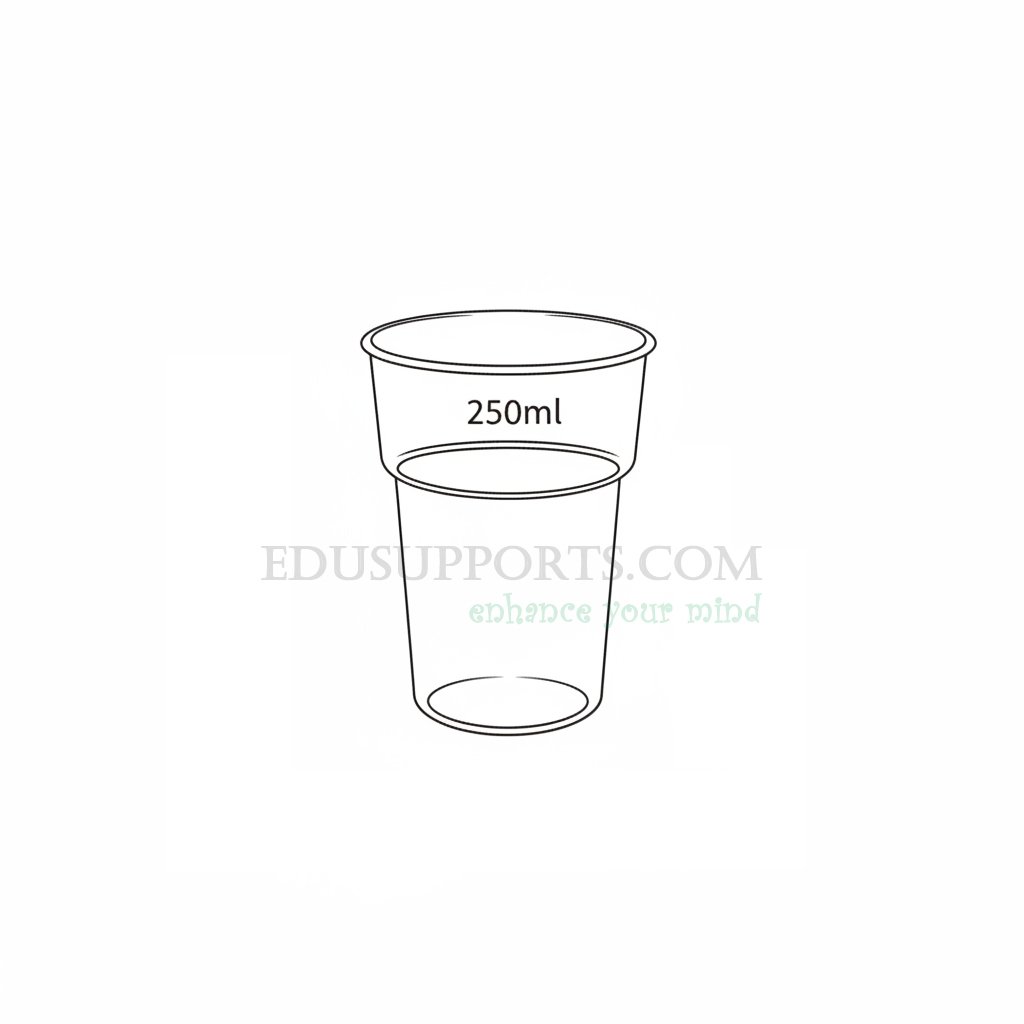
The dyeing beaker—also known internationally as the dye pot, dyeing pot, or staining beaker—features a unique inverted conical design specifically engineered for textile and dyeing industry applications. Unlike standard beakers, this vessel has a wide mouth (up to 105mm) that tapers down to a narrow base (as small as 53mm).
This distinctive shape serves multiple purposes in dyeing operations. The narrow base allows the beaker to be submerged into a water bath for uniform heating, while the widened middle section rests securely on the water bath grid—preventing the bottom from contacting the bath floor and ensuring even temperature distribution. The wide mouth provides ample space for inserting, stirring, and removing fabric samples without spilling dye solution.
EduSupports brings you this specialized laboratory vessel, manufactured from premium borosilicate glass 3.3, ensuring excellent thermal shock resistance for repeated water bath heating cycles.
Key Features
Inverted conical design – wide top tapers to narrow base for water bath compatibility
Wide mouth (95–105mm) – easy insertion and removal of fabric samples, allows clear observation of dye dissolution
Narrow base (53–75mm) – fits into standard water bath openings for uniform heating
Stepped middle section – rests securely on water bath grid, prevents bottom from touching bath floor
No spout – design prioritizes splashing prevention during fabric agitation
Borosilicate glass 3.3 – excellent thermal shock resistance for repeated water bath heating
Clear visibility – wide opening allows monitoring of dye dissolution and dyeing uniformity
Why Choose the Dyeing Beaker Design?
The dyeing beaker is purpose-built for textile and printing dyeing laboratories. Its unique inverted conical shape offers advantages that no standard beaker can match.
| Characteristic | Dyeing Beaker | Standard Beaker |
|---|---|---|
| Base width | Narrow (fits water bath) | Full width |
| Mouth width | Wide (easy sample access) | Same as base |
| Water bath compatibility | ⭐⭐⭐⭐⭐ Excellent | ⭐⭐ Limited |
| Fabric sample handling | ⭐⭐⭐⭐⭐ Easy | ⭐⭐ Difficult |
| Splash prevention | ⭐⭐⭐⭐ Wide mouth contains splashes | ⭐⭐ Moderate |
| Observation clarity | ⭐⭐⭐⭐⭐ Wide opening | ⭐⭐⭐ Good |
First, the narrow base is specifically designed to fit into water bath heating systems. This allows direct heating while the beaker remains stable and properly positioned.
Second, the stepped middle section rests securely on the water bath grid. This prevents the bottom from contacting the bath floor (which could cause uneven heating) while keeping the beaker stable during stirring and sample manipulation.
Third, the wide mouth provides exceptional access for fabric samples. During dyeing operations, textile samples (white cloth, cotton yarn, etc.) must be inserted, stirred, turned frequently, and finally removed—all without spilling hot dye solution. The wide opening makes this easy.
Fourth, the wide mouth also improves observation. The operator can clearly see whether dyes are fully dissolved and monitor dyeing uniformity throughout the process.
Specifications – Find Your Perfect Size
| SKU | Capacity (mL) | O.D. at Top (mm) | O.D. at Base (mm) | Height (mm) |
|---|---|---|---|---|
| 0503010040-01 | 250 | 95 | 65 | 128 |
| 0503010040-02 | 400 | 105 | 75 | 138 |
| 0503010040-03 | 500 | 53 | 88 | 156 |
Applications – Textile & Dyeing Industry
| Capacity Range | Typical Use |
|---|---|
| 250 mL | Small-scale dye testing, single fabric sample trials |
| 400 mL | Standard dyeing analysis, color shade and purity testing |
| 500 mL | Larger sample runs, extended dyeing time experiments |
Specifically designed for:
Textile printing and dyeing industry: Dye color quality analysis
Small-batch dyeing trials: Testing color shade and purity under different dyeing times and conditions
As a dyeing tank / dye pot: Replacement for production dyeing equipment in laboratory settings
Educational institutions: Textile and dyeing technology programs
Research laboratories: Developing new dye formulations or testing fabric compatibility
The dyeing beaker from EduSupports is specifically manufactured to meet these demanding textile laboratory requirements with consistent quality.
How to Use – Best Practices
Typical Dyeing Procedure
Clean the beaker thoroughly before use
Add dye to the beaker, then add water
Place in a water bath for heating (the narrow base fits perfectly)
Stir continuously with a glass rod until the dye is completely dissolved
Wet the test sample (white cloth, cotton yarn, etc.) with water
Insert the sample into the beaker using tweezers or a glass hook
Boil for several minutes while turning the sample frequently
Remove the sample and rinse carefully with clean water
Cleaning
Same procedure as standard beakers. New beakers rinse with tap water then distilled water. Used beakers with dye residues soak in cleaning solution, scrub with brush (pay attention to the stepped interior), and rinse with distilled water. Clean glass shows no water droplets on inner walls.
Heating Guidelines
This beaker is specifically designed for water bath heating—use is recommended over direct flame
The narrow base is optimized for insertion into water bath openings
Fill no more than 2/3 of capacity when heating (leave room for fabric samples)
Always dry the outer wall before heating
After heating, cool on a wooden board or ceramic mat
Safe Handling
Move by gripping the wide rim or middle section—note there is no pouring spout
When stirring fabric samples, use a glass rod or stainless steel tweezers, not fingers
Not suitable for hydrofluoric acid (HF)
Use caution with hot dye solutions—dyes may stain skin and clothing
Specific to Dyeing Beakers
The stepped design sits securely on water bath grids—ensure proper seating before adding samples
Wide mouth allows easy sample turning during boiling—use a glass rod to flip fabric samples every 30-60 seconds
Observe dye dissolution through the wide opening before adding fabric samples
For multiple dye tests, use separate beakers to prevent color cross-contamination
Why EduSupports?
EduSupports delivers quality labware designed for education, textile industry, and research budgets. Our dyeing beaker uses borosilicate glass 3.3 ensuring excellent thermal shock resistance for repeated water bath cycles. We offer sizes from 250mL to 500mL, covering the standard dyeing test volume range. Uniform wall thickness ensures consistent heating, and our lab-friendly pricing makes professional glassware accessible to textile mills, dyeing laboratories, and educational institutions worldwide.
Each dyeing beaker from EduSupports is manufactured with precise inverted conical geometry—optimizing the balance between water bath compatibility and sample handling convenience.
Alternatives & Naming Conventions
This product is known by multiple names in different contexts:
| Name | Context |
|---|---|
| Dyeing beaker | General laboratory term |
| Dye pot / dyeing pot | Industrial textile mill terminology |
| Staining beaker | Some research applications |
| Textile beaker | Industry-specific |
Key distinction: Unlike standard beakers, the dyeing beaker has no pouring spout. The wide mouth design prioritizes sample access and splash prevention over pouring convenience.
Quick Summary – At a Glance
✅ Inverted conical design – wide mouth, narrow base
✅ Borosilicate glass 3.3 – thermal shock resistant for water bath use
✅ No spout – wide mouth for fabric sample access and splash prevention
✅ Water bath compatible – narrow base fits standard water bath openings
✅ Perfect for textile dyeing – color quality analysis, small-batch trials
✅ 250mL, 400mL, 500mL – three sizes for standard dye testing volumes
✅ SKU sequence: 0503010040-01 to -03
✅ EduSupports – quality labware for textile and dyeing industry
 English